Are you using reactive events to drive a proactive culture?
Learn how to use your leading indicators to achieve your business objectives.
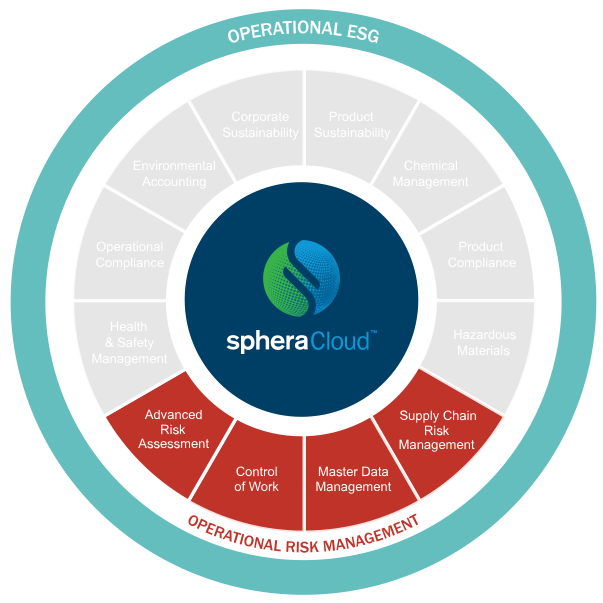
Operational risk management (ORM) for most businesses today, is much broader than losses, insurance and claims. In fact, the goal of ORM is to manage any facet of risk that threatens a company’s ability to achieve its strategic objectives. The desired outcome of a fully integrated enterprise-level operational risk solution is to perfect business process execution and repeat those best practices across the enterprise. For example, banks have moved consumers to online banking and now process millions of electronic checks per day. They achieved this by perfecting the process of one electronic payment and then repeating it millions of times per day. Reducing the variability in process execution produces more predictable financial and operational results for the entire organization.
-
The scope of ORM ranges from financial elements that focus on prudent capital allocation, human resources in areas of resource allocation and safety, and asset management in areas of quality and availability. Almost every company can benefit from the implementation of an operational risk management initiative to help ensure that their strategic objectives are accomplished.
Key to the successful execution of an ORM strategy is continuous improvement, which lies in the organization’s ability to establish a common platform for mitigating risk exposures discovered from both reactive (incident-based) and proactive (assessment-based) processes. Integration of these typically disparate processes and systems provide leaders with information that raises the awareness of and improves responsiveness to resolving management system weaknesses. These weaknesses expose the company to operational risks, compliance issues, and other costly consequences.
-
This paper will review the findings of research with leading energy companies that provided us with access to their leading indicators. It also summarizes the chain of events that tie safety performance improvements to gains in productivity and overall operations integrity. By executing this approach, companies can establish a continuously improving safe work environment as well as another means to yield greater return from their business operations.
This paper will:
- Review the leading indicator research findings drawn from analyzing a large energy industry data set. The source of research includes QHSE management system practices and data spanning more than 100 countries involving some global industry leading companies.
- Reveal the common set of factors that were found to best predict the safety outcome performance of an organization
- Provide creative solutions to reach out to front-line workers and leaders to engage them directly in the process of continuously improving safety QHSE performance.
- Outline a sample process for implementing practical, actionable leading metrics in each key area to drive line manager / leadership behavior
-
- Why do lagging metrics dominate corporate KPIs?
- The Key: Buy-in from Operational Management
- Leveraging Existing Practices to Minimize the Effort
- The Core Elements of Risk Reduction Cycle Processes
- Data from Incidents / Near Miss Processes
- Data from Proactive Assessment-based Processes
- Providing Proof of Impact on QHSE Performance
- A Structured Approach: DMAIC
- Defining Leading Indicators – Getting Started
- Measuring to Establish Indices
- Analyzing to Find the True Leading Indicators
- Executing Continuous Improvement with Leading Indicator KPIs
-
Joe Stough, Vice President-Innovation Technologies
As Vice President-Innovation Technologies at IHS, Joe Stough pursues measurable organizational factors that enable IHS clients to achieve safer work environments and more sustainable operations that can drive continuous sustainability performance improvements. Mr. Stough has an extensive professional background in large scale database software design and leads the innovation of solutions that successfully combine the disciplines of enterprise-level business software and advanced statistical analysis.
-
The IHS Operational Risk Solution™ provides visibility into your risk profile, prevents losses and increases shareholder value through continuous improvement. We support risk management best practices for compliance with regulations, standards and policies while promoting awareness and accountability enterprise-wide. Proactive and predictive, this IHS solution drives operational excellence so you can achieve your business goals.
Read more about the IHS Operational Risk Solution.